Trusting AI When the Stakes Are High

New research into how transparency, explanation, and human-centered design shape confidence in AI-assisted decisions.

What Our Research Revealed About Human-Centered Decision Making

Artificial intelligence is increasingly shaping more decisions that affect people’s lives, from choosing healthcare coverage and planning for retirement to making financial decisions, navigating major purchases, and evaluating important life choices. As AI capabilities continue to evolve, organizations face a growing challenge: people aren’t simply evaluating the recommendation itself. They’re deciding whether they trust the experience that produced it.
 
That’s an important distinction.
 
Trust is built through thoughtful design, not an algorithm. When people understand how AI developed a recommendation, they can explore alternatives, ask questions, and understand that they remain in control of the final decision. They’re far more likely to move forward with confidence. When those elements are missing, uncertainty often fills the gap.
 
As part of our ongoing exploration of human-centered AI, we set out to better our understanding of how the visibility of AI influences trust during high-stakes decisions. To do this, we studied health insurance plan selections — a complex, difficult-to-reverse decision with significant financial and personal implications, where AI is increasingly being introduced to simplify an overwhelming process.
 
While the context was healthcare, the questions we explored applied across all industries: How does AI affect trust? What helps people feel confident in AI-supported recommendations? And what role should AI play when outcomes matter most?

What We Learned About Trust in AI

Forty participants across two age groups (35–49 and 50–64) completed the same plan selection exercise. Half interacted with an experience where AI was clearly identified throughout the journey. The other half used an experience where AI worked quietly in the background until a recommendation appeared. Both groups received the same recommendation.
What changed was how people responded once they realized AI was involved.
 
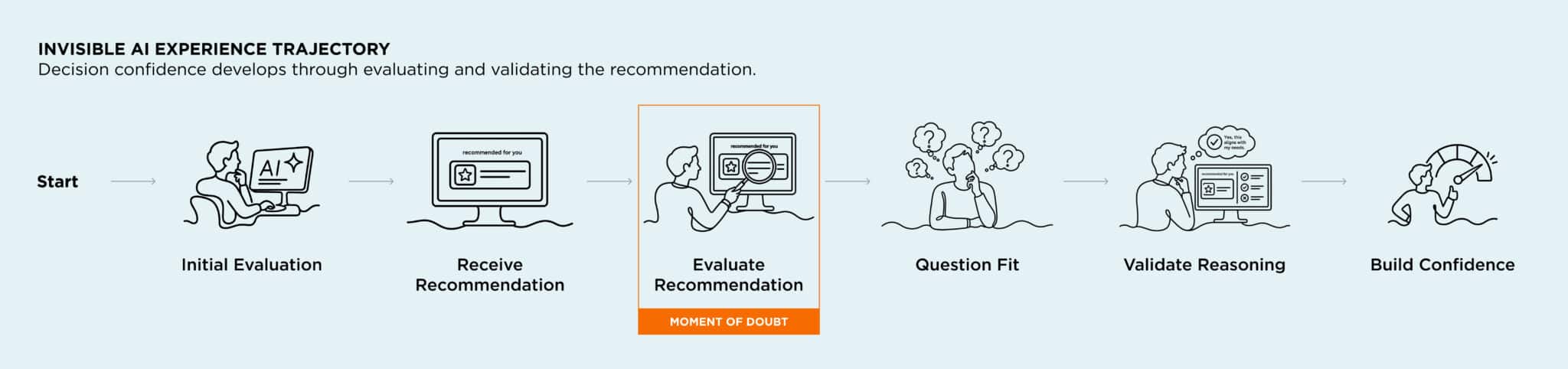
Some participants appreciated knowing AI was part of the experience from the beginning. Others became more cautious the moment they recognized it had influenced the outcome. In both cases, noticing AI shifted attention away from the recommended content and toward how the recommendation was developed. That shift consistently led to deeper evaluation.
 
Participants wanted to understand the reasoning behind the recommendation, compare alternative options, and, in many cases, validate the recommendation through a conversation with a chatbot or another person before making a final decision. The recommendation alone wasn’t enough to create confidence. The experience surrounding it mattered just as much.

Trust Grows Through Understanding

While participants reacted differently depending on when AI became visible, their underlying needs were remarkably consistent. When AI was introduced upfront, many appreciated the transparency. At the same time, some became concerned that the technology was taking on too much of the decision-making without fully understanding their personal context.
When AI remained in the background, participants often accepted the recommendation more readily at first. Once they realized AI had been involved, however, many users wanted greater visibility into how the recommendation was generated.
 
Across both experiences, confidence consistently increased in two moments:
 
  • When people could clearly see the reasoning behind the recommendation.
  • When they could compare the recommended option alongside meaningful alternatives.


These moments transformed AI from an invisible algorithm into a collaborative partner that helped people think through an important decision. One participant captured this balance well:
 
“It can help me make decisions, but it should not be my decision maker.”
 
We see this less as resistance to AI and more as a clear expectation for how AI should participate in decision-making. People value AI that strengthens their judgment while leaving space for their own agency — especially when the stakes are high.

Seven Principles for Designing Human-Centered AI

Our research surfaced seven design principles that organizations can apply when introducing AI into customer experiences. Together, they shift AI from a black box to a trusted part of the decision-making journey.

1. Disclose AI

People appreciated knowing AI was involved from the beginning. Naming it openly establishes trust and prevents the feeling of discovering something important after the fact. Transparency isn’t simply about compliance — it helps set expectations before people begin evaluating recommendations.
 

2. Show the Reasoning

Participants wanted more than an answer. They wanted to understand why that answer made sense.
Recommendations become easier to trust when they’re presented as conclusions people can evaluate rather than decisions they are expected to accept. Plain-language explanations help people build confidence in both the recommendation and the experience itself.
 

3. Reveal All Options

Confidence grew when participants could compare the recommended plan against other viable options.
Comparison creates context. Rather than reinforcing a single “best” answer, it helps people understand the tradeoffs behind the recommendation and arrive at a decision they can confidently stand behind.
 

4. Provide an Opt-Out

Not everyone wants to engage with AI in the same way. Some participants wanted greater control over the information they shared or preferred to complete more of the process themselves before receiving a recommendation. Providing an alternative, more manual path acknowledges those differences and gives people the flexibility to engage at a pace that feels right for them.
 

5. Remove Pressure to Decide Quickly

Participants were more comfortable with AI recommendations when they felt they had time to review, compare, and return to their decision, rather than acting immediately. Designing experiences that support saving progress, revisiting recommendations, and setting their own timelines helps people feel more confident and in control of important choices.
 

6. Keep a Channel for Conversation Open

Questions are a natural part of important decisions. Participants consistently wanted opportunities to ask follow-up questions in their own words, whether through a conversational AI assistant or another interactive experience. Dialogue builds understanding in ways static recommendations cannot.
 

7. Ensure There’s An Option to Reach Out

Even in highly digital experiences, people wanted reassurance that knowledgeable humans remained part of the process. Knowing they could connect with a person if they had questions, wanted a second opinion, or encountered a more complex situation made participants more comfortable relying on AI recommendations in the first place.

Why This Matters for Every Industry Introducing AI

Although our study focused on health insurance, the implications extend far beyond it. The same trust dynamics show up wherever AI is being introduced into complex, high-stakes customer decisions — retirement planning, wealth management, lending, benefits enrollment, healthcare navigation, and major purchases, to name a few.
 
For organizations investing in AI-enabled experiences, our research points to a clear reality:
 
Trust is becoming a competitive differentiator.
 
The quality of the recommendation matters. But the quality of the experience surrounding that recommendation may matter even more. When people trust the experience, they engage more deeply, make more decisions, and return with greater confidence. When they don’t, even the most accurate recommendation can go unused.

put humans at the center

Need Help Making Your Strategy Human-Centered?